
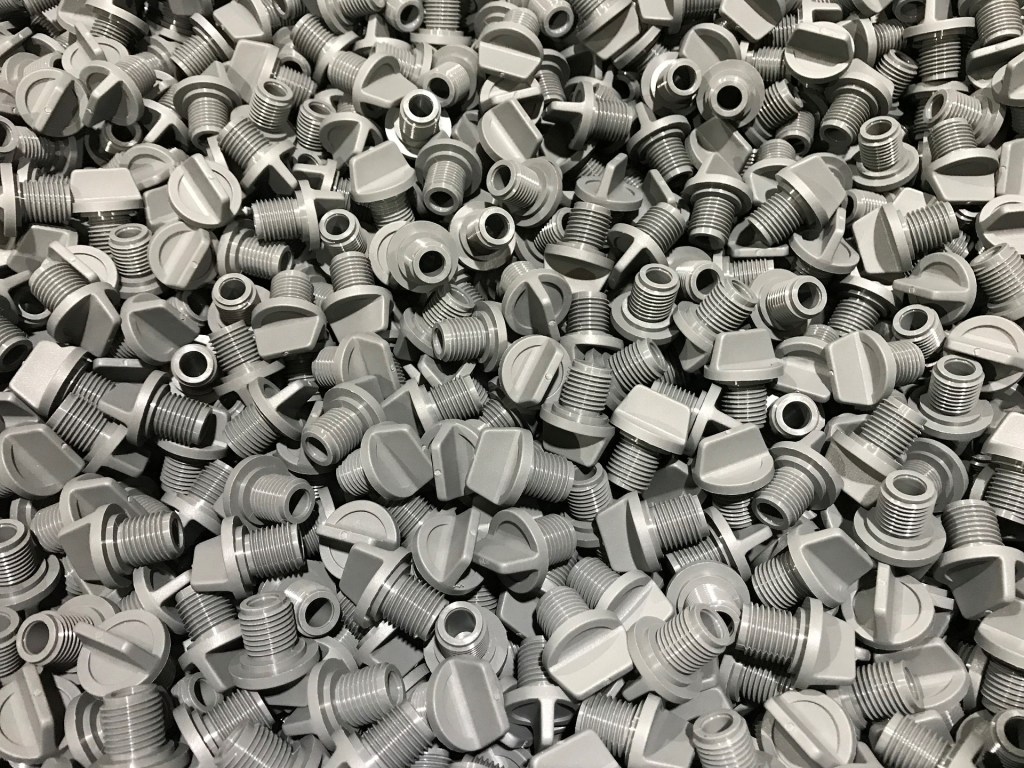
When it comes to producing large quantities of plastic parts, injection molding is one of the best ways to accomplish this task. It is consistent and when it is done correctly the per part cost for injection molded parts can be relatively inexpensive compared to other methods. In order to achieve low costs per part and to save costs on the overall process you will want to perform design for manufacturing (DFM) on your injection molded parts. By completing DFM you can save a lot in costs and improve the quality of your part.
What is the goal of DFM
Before diving into the different ways you can implement DFM with injection molded parts I want to explore the goal that we are trying to achieve. When I go into designing a part for injection molding I look to achieve three things; was the purpose of the part achieved, how the quality be improved, and how can more costs be saved. As an article from PCI states “The goal of DFM is to deliver greater levels of customer satisfaction, lower production costs and greater profits.” (1) When implementing for DFM you have to consider purpose, quality, and cost. Trying to implement one or two and not the other will fail to achieve what your end product needs to be.
5 Tips to implement DFM for your Injection Molded Parts
- Select the right material.
This in my opinion is one of the most important tips in implementing DFM for your part. Material can make or break your product. When going to select your material, look closely at the material qualities and the cost. Often times we find a material that fits the purpose and quality we need but neglect the costs even though there might be a cheaper material that suites your purposes as well. Work closely with your injection molder to get the material that is right for you(1).
I had a project where I was able to save cost on the part by selecting a material that was cheaper and still met the needs and quality I wanted. In this project I was looking for a material that I could use with water but it was also used in a medical device adding to different needs of the product. Medical grade plastic can easily raise costs, so it was important that I find a material that suited what I needed but kept costs low. Eventually I found a material that was a decent cost and was within the specifications I needed.
- Add draft and radii to your part.
Draft and radii are two features you can add to the design of the part that will improve the performance of the part being injection molded. With draft added the part can more easily be released from the mold due to less drag on the part’s surface. The rule of thumb when adding draft is to add 1 degree of draft for every inch of cavity depth. Radii helps to eliminate sharp corners allowing for better flow of the material allowing for better part integrity, better part ejection, and reduced sticking (2).
An example of this is with the design of a cap I was creating. The cap had a barb on top and a cavity on the inside. With the cavity on the inside I added a degree of draft even though the function of the part didn’t call for it. The additional draft allowed the part to come off the mold cleanly and quickly leading to better quality and lower costs.
- Consider the wall thickness.
Wall thickness has a significant impact on the cost, production speed, and quality of the final product. As parts are cooled before being ejected from the mold, thinner walls can be cooled more quickly, reducing the cycle time and the amount of cooling required.
The goal in designing for manufacturing is to choose the thinnest wall thickness possible, while still meeting structural requirements. Using less material not only reduces cost but also reduces cooling time, resulting in faster cycle times. However, the minimum wall thickness that can be used is determined by the size, geometry, and flow behavior of the resin being used. In general, the range for wall thickness is between 2 and 4mm.
It’s crucial to maintain uniform wall thickness throughout the part, as inconsistent thicknesses can lead to thinner sections cooling more quickly than thicker sections. This causes shrinkage in the thicker section, which can result in warping, twisting, or cracking. To avoid this issue, it’s essential to design with uniform wall thickness, but in cases where it’s not possible, the change in thickness should be gradual to minimize the risk of defects. (3)
I recently had to design a cap with a barb (like the example above) that required changing the thickness from the barb to the neck to the barb. To achieve this, I started by determining the minimum thickness that could be used for the neck and the barb while still meeting the structural requirements. I then gradually increased the thickness from the neck to the barb, ensuring that the change in thickness was gradual and consistent to minimize the risk of defects.
At the same time, it was crucial to keep the main section of the end cap to have a consistent wall thickness. Any variation in thickness could lead to inconsistencies in cooling and shrinkage, causing warping or cracking. Therefore, I made sure that the main section of the end cap remained uniform in thickness, with the change in thickness only occurring in the section with the barb. I would have kept the thickness the same in the barb but the design required that it be different
In the end, my design was successful, and the cap was produced without any issues. By carefully designing the wall thickness, I was able to ensure that the cap met the required structural requirements while minimizing material usage and reducing production time.
- Gate location.
Gate location is a critical aspect of designing injection molded parts for manufacturing. The gate is the point where molten plastic enters the mold cavity and fills it. Proper gate location can significantly affect the quality and consistency of the final product.
One important consideration when choosing a gate location is to place it at the heaviest cross section of the part. This allows for better part packing, minimizing the formation of voids and sink marks. Additionally, it is essential to minimize obstructions in the flow path, so gates should be placed away from cores and pins.
It is also crucial to ensure that the gate’s stress is in an area that will not affect part function or aesthetics. Using a plastic with a high shrink grade can lead to “gate pucker” if there is high molded-in stress at the gate, causing the part to warp or distort.
Another essential consideration is ensuring easy manual or automatic degating. The gate should be designed to allow for straightforward removal of the runner system, which connects the gate to the injection molding machine.
The gate should also minimize flow path length to avoid cosmetic flow marks. If filling problems occur with thinly walled parts, adding flow channels or making wall thickness adjustments can correct the flow. In some cases, it may even be necessary to add a second gate to properly fill the parts (3).
As a design engineer, I had a past project where I worked on a round housing part that required careful consideration for gate location. After analyzing the part’s geometry and wall thickness, I decided to locate the gate at the center of the part to allow for better flow and even filling of the mold cavity. In addition to optimizing flow, I also considered the part’s aesthetics and branding requirements. I chose a gate location that would allow the gate to be covered by a label, ensuring that the gate location would not be visible on the final product. To achieve this, I worked closely with the mold manufacturer to ensure that the gate location would not affect the mold’s ejection system or cause any other manufacturing issues. We also performed simulations to ensure that the gate location would result in a high-quality finished product.
In the end, the gate location I designed allowed for optimal flow and filling, while also meeting the company’s branding requirements. The final product was a round housing part with a clean, label-covered surface and no visible gate location.
- Coring Out and Ribbing
Coring out and ribbing techniques can help to increase strength, reduce defects, and improve the overall quality of the molded part.
To start with, let’s look at ribbing. Ribs are thin, vertical supports that are added to the walls of a part to increase its strength and stiffness. By distributing stress more evenly across the part, ribs can help to prevent warping, sink marks, and voids. They also provide additional support for any features or details in the part. When designing ribs, it’s important to consider the thickness of the walls they will be attached to. A good rule of thumb is to aim for a rib-to-wall thickness ratio of 40% to 60%, which will provide a good balance of strength and ease of manufacturing. The main body of the part should also be thick enough that adjacent ribs can be half the thickness without compromising the overall structural integrity.
In addition to ribs, designers can also use ramps and gussets to improve the quality of their injection molded parts. Ramps are gradual inclines that help to smooth out the flow of material as it enters the part, reducing the risk of air pockets or other defects. Gussets are small, triangular supports that are added to corners or other areas of the part where stress is likely to be concentrated. By distributing this stress more evenly, gussets can help to reduce the risk of cracking or other failures. (2)
In conclusion, designing for manufacturing is a critical aspect of injection molding. By implementing DFM, you can reduce costs, improve quality, and ensure customer satisfaction. The tips discussed in this article, such as selecting the right material, adding draft and radii, considering wall thickness, optimizing gate location, and using simulation software, are essential to achieving success in injection molding. By carefully considering each of these factors during the design process, you can create parts that are efficient, cost-effective, and meet the needs of your customers. With DFM, you can achieve greater levels of customer satisfaction, lower production costs, and greater profits.
Sources
- PCI, Rosti. “Design for Manufacturing (DFM) in Plastic Injection Molding – a Comprehensive Guide.” Rosti, https://www.plasticcomponents.com/design-for-manufacturing-in-plastic-injection-molding-guide.
- “Injection Molding Basics: An Intro to Designing Plastic Parts.” Protolabs, https://www.protolabs.com/resources/design-tips/injection-molding-basics/.
- “Basics of Injection Molding Design.” 3D Systems, 10 Apr. 2022, https://www.3dsystems.com/quickparts/learning-center/injection-molding-basics.
Image by paulJmason from Pixabay
 ThinkMedTek
Leave a comment